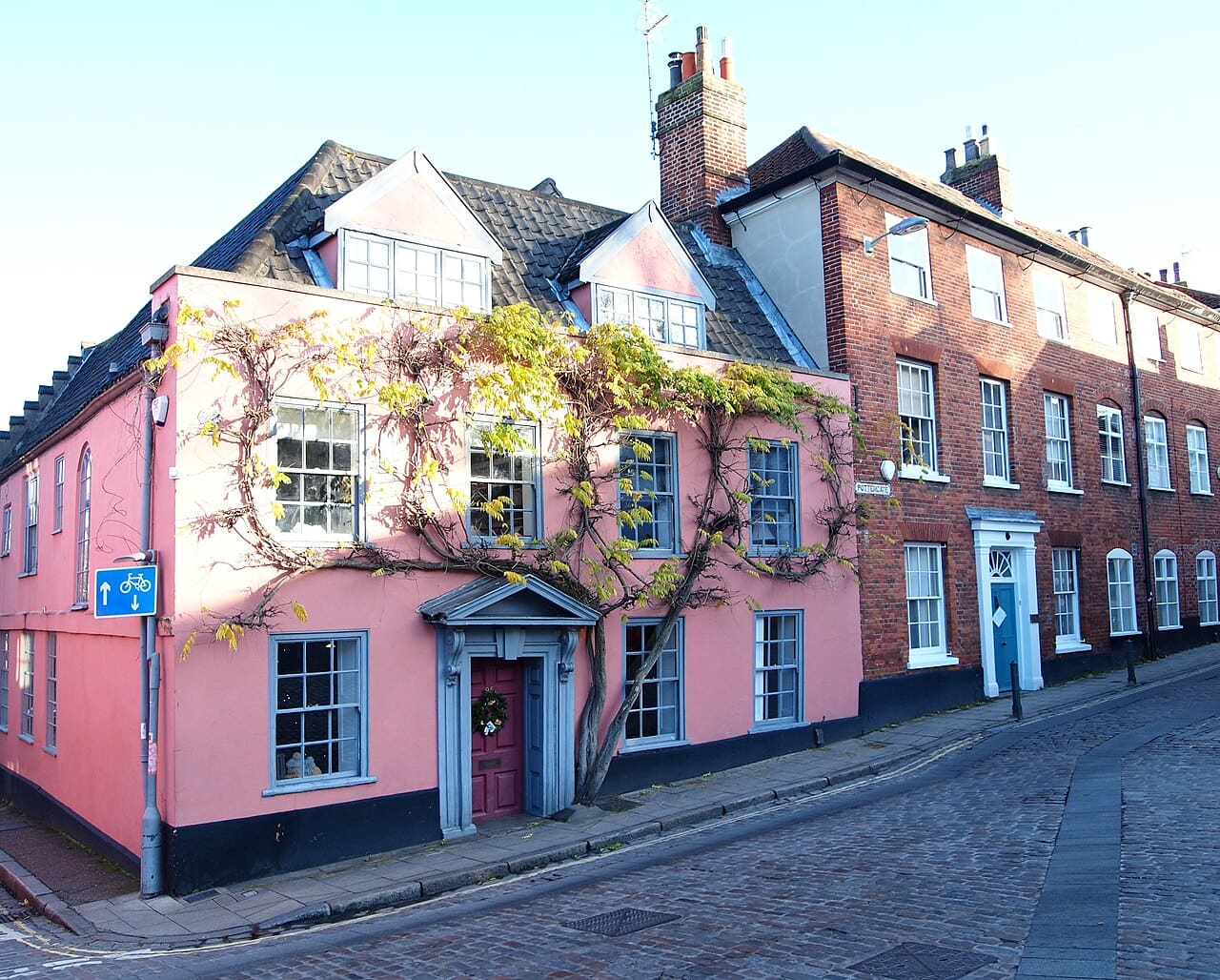
The places on this page sit within a short walk of one another, in the knot of old streets between Norwich Market and the far end of St Benedicts Street. Most are mixed kitchens that mark their vegetarian and vegan dishes, ranging from a breakfast café on a cobbled medieval street to a chef-led restaurant with a vegetarian tasting menu. Together they cover a whole day of eating without leaving the area on foot.
The cards above list them with addresses and a short description each. This page explains the streets themselves and how to string the places together.
Which streets the Lanes cover
“The Norwich Lanes” is a name for an area rather than a single road. It takes in the narrow streets and alleys that fan out west and north of the market: Pottergate, Lower Goat Lane and Upper Goat Lane, St Gregory’s Alley, St Giles Street, Charing Cross, St John Maddermarket and the cut-throughs between them. The shops here are mainly independent, and several streets are pedestrian or close to it.
St Benedicts Street continues west from Charing Cross towards the inner ring road and is usually counted as part of the same quarter, with more bars and restaurants than the core lanes. Elm Hill is a separate pocket to the north-east, reached along Princes Street or from the river, and it leads on to Tombland and the cathedral.
Medieval churches turn up on almost every corner. Norwich kept more of its medieval parish churches than most English cities, and several in and around the Lanes have found other uses as arts spaces, venues or community buildings. Strangers’ Hall, a merchant’s house museum on Charing Cross, gives a sense of how people lived in these streets several centuries ago.
A fully vegan stop: Lower Goat Lane
Moorish Falafel Bar, at 17 Lower Goat Lane, is a small independent diner and takeaway with an all-vegan menu inspired by Mediterranean and Middle Eastern cooking. Falafel wraps, salads and vegan burgers are the core of it. There is upstairs seating for anyone who wants to eat in, which is useful on a wet day when the market’s benches are less appealing.
Lower Goat Lane itself is a narrow pedestrian street linking Pottergate with the streets around the market and the Guildhall. It makes a natural lunch stop in the middle of a walk, and because Moorish Falafel Bar’s whole menu is vegan, there is nothing to check before ordering.
Breakfast at the edges: Exchange Street, St Andrews Street and Elm Hill
The Lanes listings that serve breakfast sit around the edges of the area rather than in the middle.
No33 Exchange Street is between the market and the Lanes. It is an independent brunch café with cooked breakfasts, pancakes, loaded brunch plates, speciality coffee and cakes, and its menu has a separate vegan section with its own breakfast, pancakes and naanwich.
Shako Mako, at 1 St Andrews Street, is a small café on the north-eastern edge of the Lanes, close to St Andrew’s and Blackfriars’ Halls. Its kitchen cooks Iraqi home-style dishes, kubba, tabsi and fool among them, and keeps an all-day breakfast going with cakes and coffee alongside. A legend on the menu separates vegetarian dishes, vegan dishes and dishes with a vegan option, and the café calls itself vegan friendly.
Olive’s, at 40 Elm Hill, is a breakfast café best known for griddled sandwiches and full cooked breakfasts. Beside the meat dishes it lists a vegetarian breakfast and a vegan breakfast with chickpea scramble and vegan black pudding. The brunch guide compares these with the other breakfast cafés in the city.
Lunch in the Lanes
Lunch is the easiest meal to eat in the area, because almost every listing serves it. Moorish Falafel Bar is the quick choice, with wraps to take away or eat upstairs. Bombai serves a thali at lunchtime, which is a good way to try several dishes without committing to an evening of sharing plates, and Benedicts opens for lunch on some days of the week. No33, Olive’s and Shako Mako all carry on from breakfast into lunch.
A sunny day changes the calculation. Several of the Lanes’ churchyards are open green spaces, and a takeaway wrap on a bench by a medieval church tower is as good a lunch as any table indoors.
Elm Hill and Tombland in the morning
Elm Hill deserves a little time of its own. The cobbled street of timber-framed and colour-washed houses curves down from Princes Street towards the River Wensum, and most of its buildings were put up after a fire swept the area in 1507. It is quiet early in the day, before the shops open, which makes breakfast at Olive’s a good way to see it.
From the top of Elm Hill it is a couple of minutes to Tombland, the open space in front of Norwich Cathedral’s gates. The cathedral close beyond is free to walk through, and the cloisters are among the largest in England. If you start the day here, the Lanes proper are about ten minutes’ walk back towards the market, along Princes Street and London Street or through the streets around St Andrew’s.
St Benedicts Street after dark
St Benedicts Street has a different rhythm from the rest of the quarter. Its shops close in the late afternoon and its bars and restaurants take over, so it is where the Lanes’ evening eating happens.
Bombai Indian Street Food, at 38–40 St Benedicts Street, serves small sharing plates in the evening and a thali at lunchtime. Its vegan menu is a separate document, covering bang bang cauliflower, pani puri, chana masala, tarka dal and more, which makes it the simplest choice for a vegan group arriving without a plan.
Benedicts, at number 9, is chef-led and modern British, offering both a tasting menu and à la carte, with menus rewritten every few weeks. It publishes a vegetarian tasting menu and prepares a vegan menu with advance notice. It suits a planned evening rather than a walk-in, and the vegan dinner guide covers it alongside the city’s other evening options.
One thing to look out for on the walk: towards the western end of the street stands the round tower of St Benedict’s church, the only part of the building to survive bombing in 1942. It has nothing to do with dinner, but it explains the street’s name.
Most meals here come from a mixed menu, and the details differ by cuisine.
At Moorish Falafel Bar there is nothing to check: every dish, sauce included, is vegan. At the breakfast cafés, the questions are the familiar ones about butter on toast, egg in pancakes and what goes on the griddle; No33 and Olive’s both write a vegan breakfast as a dish of its own, which settles most of them. At Bombai, the separate vegan menu covers the issue of ghee and yoghurt, which otherwise turn up in many Indian dishes. At Benedicts, the vegetarian tasting menu may include dairy and egg, and the vegan version exists only when requested ahead.
Shako Mako sits between these. Its legend marks dishes as vegetarian, vegan or vegan on request, and the café calls itself vegan friendly, but many of its dishes appear on the menu as images rather than text. Asking at the counter is the quickest way to confirm a particular plate.
Steps, cobbles and getting around
The Lanes are old streets, and that shows underfoot. Elm Hill is cobbled from end to end, some of the alleys are narrow, and several streets slope. St Benedicts Street, Exchange Street and the area around the market are wider and flatter, and they are the easier routes for wheelchairs and pushchairs.
Indoors, layouts vary. Moorish Falafel Bar’s eat-in seating is upstairs, so anyone who cannot manage stairs may prefer to take food away and eat elsewhere. The guide does not record step-free access for each venue, because it is not something every venue publishes, so a quick check with the venue before a visit is the reliable route.
Rain is the other practical concern. The covered Royal Arcade and the market’s canopies give some shelter, and the Forum, the large glass building beside St Peter Mancroft church at the top of the market, is a useful place to wait out a shower between meals.
A route that links them
Because the places are close together, a single loop takes them in, and the order can be reversed for an evening start.
- Start on Elm Hill with breakfast at Olive’s, then walk up to Tombland and the cathedral.
- Head back along Princes Street to St Andrews Street, passing Shako Mako for a coffee.
- Cross towards the market and Exchange Street, where No33 sits at the edge of the Lanes.
- Walk up Lower Goat Lane for lunch at Moorish Falafel Bar.
- Wander along Pottergate and St Gregory’s Alley in the afternoon.
- Finish on St Benedicts Street with dinner at Bombai or, if booked, Benedicts.
Walking time without stops is well under half an hour. With meals and browsing it makes a full and unhurried day.
The Lanes sit right beside Norwich Market, and the market is the better bet for anyone cooking as well as eating out. Its rows of stalls under striped canopies have traded on the slope below City Hall since the Norman period, and fruit and vegetable stalls are part of the mix. What they sell changes through the year, and the seasonal calendar shows which UK crops are at their peak each month, from Norfolk asparagus in late spring to squash and apples in autumn.
Herbs are worth picking up on the way past. A bunch of fresh thyme goes into almost every slow-cooked bean dish and roast vegetable tray, and the wild thyme section explains how to grow your own on a windowsill or in a pot. If you would rather leave the cooking to someone else, the full list of checked places across the city is on the homepage, and the Norfolk Wildlife Trust is the place to look if a day in the Lanes leaves anyone wanting fresh air on the county’s heaths and coast.
A practical note to finish: several of the Lanes streets are pedestrian, so the area is easiest to reach on foot or by bus, and Castle Meadow and St Stephens Street, where many city routes stop, are both a few minutes’ walk from the market.