
Journal · summer
Wild Thyme in Flower on the Brecks: Where to See It and How to Visit
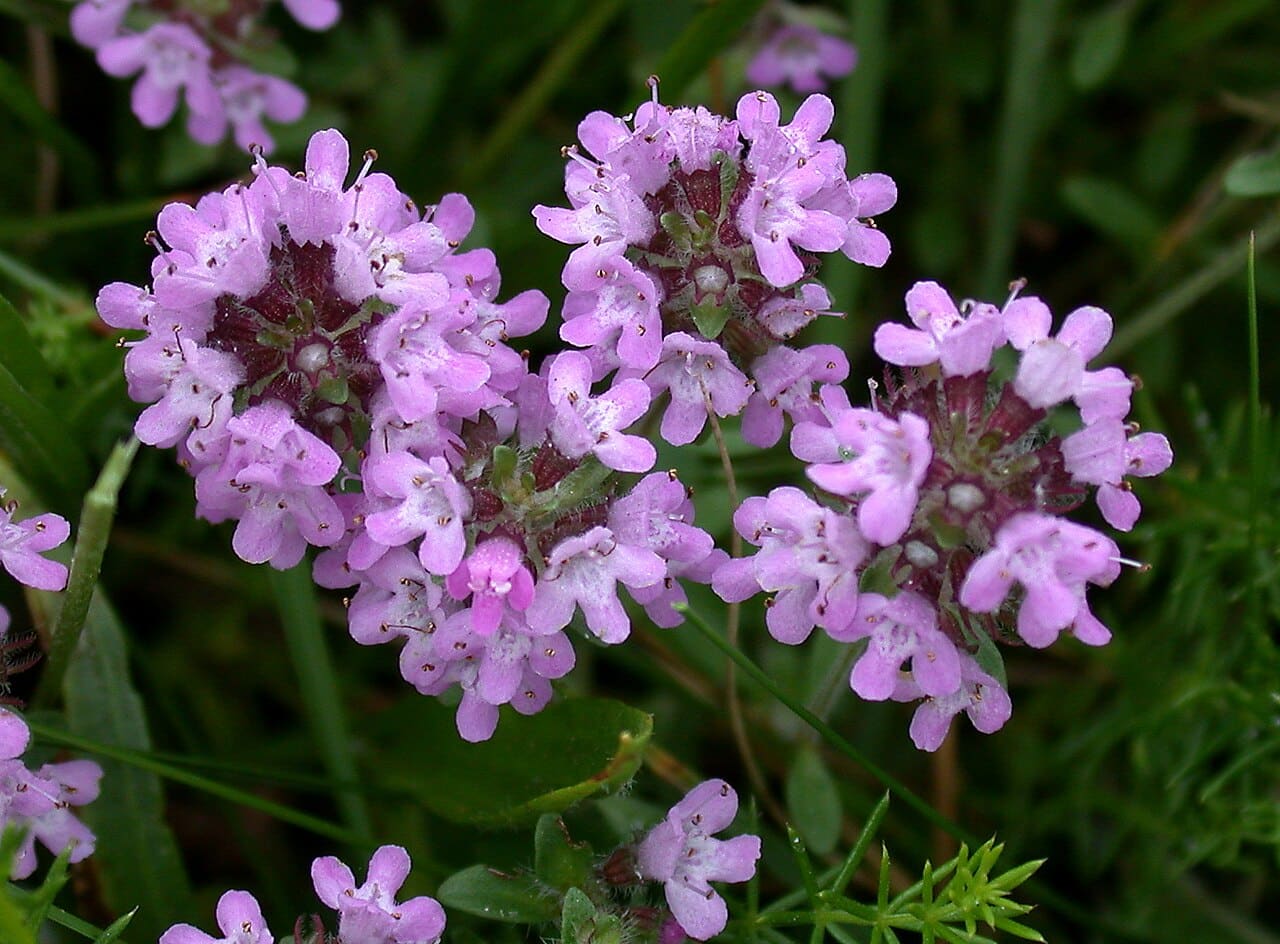
By the third week of July the turf on the open Brecks is barely ankle-high, cropped close by rabbits and sheep, and in places it is stitched through with small mats of pinkish purple. Kneel down and the scent arrives before anything else: warm, resinous and unmistakably thyme. On a still afternoon the mats hum with bees.
This is one of the best botanical shows in East Anglia, and one of the least noticed, because it happens at the level of a boot sole. Breckland, the dry sandy country that straddles south-west Norfolk and north-west Suffolk between Thetford, Brandon and Bury St Edmunds, holds some of the most important thyme grassland in Britain.
Why thyme grows so well on the Brecks
The Brecks have the driest, most continental climate in lowland England, with low rainfall, hot summers and hard winters, sitting on thin sand laid over chalk. Water drains away almost at once. Few vigorous grasses can cope with that, which leaves room for small, slow, drought-tolerant plants that would be smothered in a richer field.
Grazing keeps the turf short. Rabbits have shaped Breckland grassland for centuries, and conservation grazing by sheep now does the same job on many reserves. Natural England’s citation for the Breckland Special Area of Conservation describes the most extensive surviving examples in Britain of a grassland type defined by sheep’s fescue, mouse-ear hawkweed and thyme. In plain terms, thyme is one of the plants that makes this habitat what it is.
The name of the region itself has a story, and it is an aside worth having. “Breckland” was coined in 1894 by the Norfolk naturalist W. G. Clarke, from the local word “breck” for a patch of heath broken up for cultivation for a few years and then left to go back to rough grazing. Before then it had no single name at all.
Two thymes, one rare
There are two creeping thymes to look for, and telling them apart is half the pleasure of a visit.
Wild thyme (Thymus polytrichus, often listed in older books as T. praecox or T. drucei) is the common native thyme of dry grassland, cliffs and dunes across Britain. It forms flat mats of small oval leaves with rounded heads of pink-purple flowers. On the Brecks it is widespread wherever the turf stays short.
Breckland thyme (Thymus serpyllum) is the rarity. In Britain it is almost entirely confined to Breckland, where it has been recorded since the eighteenth century, and many former sites were lost to forestry and ploughing in the twentieth. The Botanical Society of Britain and Ireland’s rare plant records for the area note that the recovery of rabbits and the return of sheep grazing have helped it hold on at its remaining sites.
The reliable way to separate them is to look at the flowering stems with a hand lens. Wild thyme has hairs on two opposite faces of the square stem, with the other two faces almost bare. Breckland thyme is hairy evenly all the way round. A third species, large thyme (Thymus pulegioides), grows on some chalkier patches; it is taller and more upright, with hairs mainly on the four corners of the stem. Flower colour and leaf size vary too much to be trusted on their own.
| Species | Common name | Stem hairs | Where on the Brecks |
|---|---|---|---|
| Thymus polytrichus | Wild thyme | On two opposite faces | Widespread in short turf |
| Thymus serpyllum | Breckland thyme | Evenly all round | A small number of grassland sites; rare |
| Thymus pulegioides | Large thyme | Mainly on the four angles | Chalkier, slightly taller grassland |
Our page on wild thyme covers the native species in more detail, and the guide to creeping thyme explains how the garden forms relate to the wild plants.
Where to look
Most Breckland thyme grassland lies on nature reserves, heaths managed for conservation and a few historic sites. Some places where thyme is documented, and which have public access, are a good starting point.
Weeting Heath, near Brandon, is a Norfolk Wildlife Trust reserve best known for its stone-curlews, which nest on the open ground in spring and summer. Its short, grazed turf on dry, chalky sand is the kind of ground wild thyme favours, though the reserve is managed first for its birds and the plant list changes with grazing. Access arrangements, opening and charges are set by the Trust, so it is worth checking the Norfolk Wildlife Trust website before going.
Grime’s Graves, north of Thetford, is an English Heritage site where Neolithic people dug for flint, leaving a strange field of grassy hollows. Historic England lists Breckland wild thyme among the wildflowers of the site, and the pitted ground is grazed short enough for it to thrive. The site has seasonal opening, so check before travelling.
West Stow Heath, beside West Stow Country Park in Suffolk, is described in its site records as holding three nationally rare plants, Thymus serpyllum among them. Footpaths run from the country park and the reconstructed Anglo-Saxon village.
Other Breckland heaths such as East Wretham Heath and Knettishall Heath have short grassland where thyme can be expected, but they have not been checked plant by plant for this piece. A good field guide and a slow walk will often turn up thyme on any well-grazed Breckland turf.
When to go
Wild thyme flowers from June into August, and July is usually the peak. The best visit is a warm, sunny afternoon after a dry spell, when the leaves release the most scent and the flowers are busy with honeybees, bumblebees and small butterflies. Overcast mornings are disappointing; the mats look dull and the scent barely lifts.
July is also a good month for other Breckland plants, so a visit can easily become a longer botanising walk. Our seasonal notes on what’s in season cover the cultivated side of the same months.
What else flowers in the same turf
Thyme rarely flowers alone on the Brecks. The same short grassland holds a set of plants that are characteristic of the region, and a July walk is a good chance to see several together.
Viper’s-bugloss is the easiest to spot: tall spikes of vivid blue flowers rising out of disturbed sandy ground and track edges, often busy with bumblebees. Lady’s bedstraw forms frothy yellow patches in the turf and smells faintly of honey on a warm day. Harebells hang their pale blue bells from thin stems later in the summer. On the open heath, heather starts to colour towards the end of July, and the sandier, more acid ground carries sheep’s sorrel, which turns whole patches rusty red as its seeds ripen.
The real Breckland specialities are harder to find. Spanish catchfly, a slender plant with tiny greenish-yellow flowers, is a rarity of a few grassland sites. Field wormwood, another Breckland plant that is extremely rare elsewhere in Britain, flowers later in the summer on sandy verges and banks. Purple milk-vetch, another plant of chalky Breckland turf, flowers earlier and may still be in flower in a cool year. Most of these grow on protected sites, and a good illustrated flora is the best companion for looking.
Insects follow the flowers. Thyme is a favourite nectar plant for bees, and in July the mats attract small butterflies and day-flying moths as well. On a hot afternoon it is worth simply sitting at the edge of a path for ten minutes and watching what arrives.
What to bring
A visit to the Brecks in July needs very little equipment, but a few things help. A hand lens for checking thyme stems is the most useful single item. Water and sun protection matter more than people expect, because the open heaths have little shade and the sandy ground reflects heat. Long trousers are sensible on rough ground, where ticks can be present in summer. A camera or phone with a macro setting will record the stem hairs well enough to confirm an identification at home.
Binoculars are useful as well, less for the plants than for the birds that share the heath: stone-curlews are best watched from the hides at a distance, and a woodlark singing overhead is easy to hear and hard to pick out without them.
A printed or downloaded map of the reserve is worth having too, since mobile signal can be patchy on parts of the heath, and some sites have more than one entrance with different parking.
How to visit without doing harm
Breckland grassland is fragile, rare and largely protected. Most of the sites above are Sites of Special Scientific Interest, and several hold birds that nest on the bare ground. Stone-curlews and woodlarks are easily disturbed, so the paths and hides on reserves are placed to keep visitors at a distance, and the signs at entrances tell visitors which areas are closed.
The basics are simple. Keep to marked paths and open-access areas, and do not walk onto fenced or signed plots. Keep dogs on a short lead where they are permitted, and leave them at home where they are not. Follow the Countryside Code, which covers gates, livestock and litter. If you kneel to look at a thyme mat, choose a spot on the path edge rather than pressing into the middle of the turf.
Do not pick the thyme. Uprooting any wild plant without permission is an offence under the Wildlife and Countryside Act 1981, reserves and SSSIs have their own protections, and Breckland thyme in particular is rare enough that every plant counts. Picking a few sprigs from a protected heath also strips nectar from insects at the time they need it most. A photograph and a note of the stem hairs make a far better souvenir.
Bringing thyme home the right way
For anyone who leaves the Brecks wanting thyme in the garden, the answer is the nursery rather than the heath. Garden forms of creeping thyme, such as Thymus serpyllum ‘Russetings’ or the woolly Thymus pseudolanuginosus, grow well in a sunny, gritty bed or between paving, and our page on growing thyme from seed covers the slower route.
Plantlife’s pages on wild plants are a good place to read further about native thymes and the grassland they depend on, and Plantlife runs the annual No Mow May campaign that encourages short, flower-rich lawns. A small patch of lawn mown short and left unfed will sometimes produce its own thyme in a dry year.
The most useful thing to pack for the Brecks in July is not a basket but a hand lens: ten times magnification, a cord round the neck, and a few minutes on a path edge counting hairs on a thyme stem.
Questions
When does wild thyme flower in Breckland?
Wild thyme on the Brecks usually flowers from June into August, with July normally the best month for a good show. Timing shifts a little with the weather: a hot, dry spring brings flowers on earlier, and grazed turf on the open heath often flowers more freely than taller grassland. A sunny afternoon is best, when the scent is strongest and bees are working the flowers.
Is it legal to pick wild thyme on the Brecks?
The Wildlife and Countryside Act 1981 already makes it illegal to dig up a wild plant unless the landowner has agreed, and most Breckland heaths are nature reserves or Sites of Special Scientific Interest where picking is not appropriate at all. Breckland thyme is also nationally rare. The plants are best left for the bees and photographed instead; culinary thyme is easy to buy or grow.
What is the difference between wild thyme and Breckland thyme?
Both are low, creeping native thymes with pinkish-purple flowers. Breckland thyme (Thymus serpyllum) is rare in Britain and almost confined to the Brecks; its flowering stems are evenly hairy all round. Common wild thyme (Thymus polytrichus) is widespread on dry grassland across the country, and its stems are hairy on two opposite sides only. A hand lens makes the check easy.
Can dogs come onto Breckland heaths in summer?
On many heaths dogs are welcome on a short lead, but rules vary by site and some reserves do not allow them at all, particularly where stone-curlews and woodlarks nest on the ground. Check the managing organisation's page before setting out, and follow the signs at the entrance. Keeping to the marked paths matters as much as the lead.