
Wild thyme field guide
Creeping thyme: red varieties, lawn planting and growing from seeds
On this page11 sections
- What gets sold as creeping thyme
- Red creeping thyme and what the label means
- A table of varieties the RHS describes
- Buying plants: what to look for
- Where creeping thyme grows best
- Creeping thyme from seeds or from plants
- Using creeping thyme as a lawn
- Planting out and spacing
- Trimming, dividing and starting again
- Bees, butterflies and the summer flush
- What to watch for
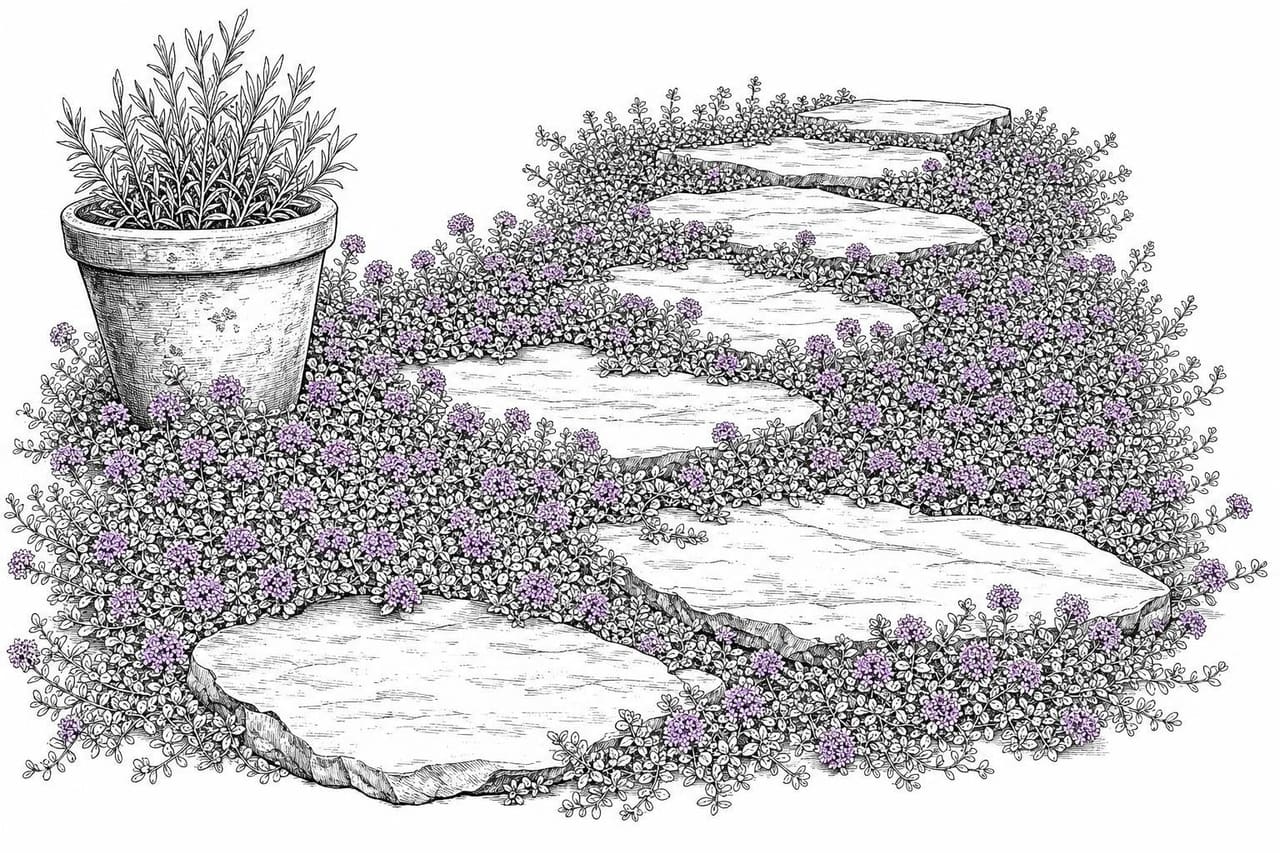
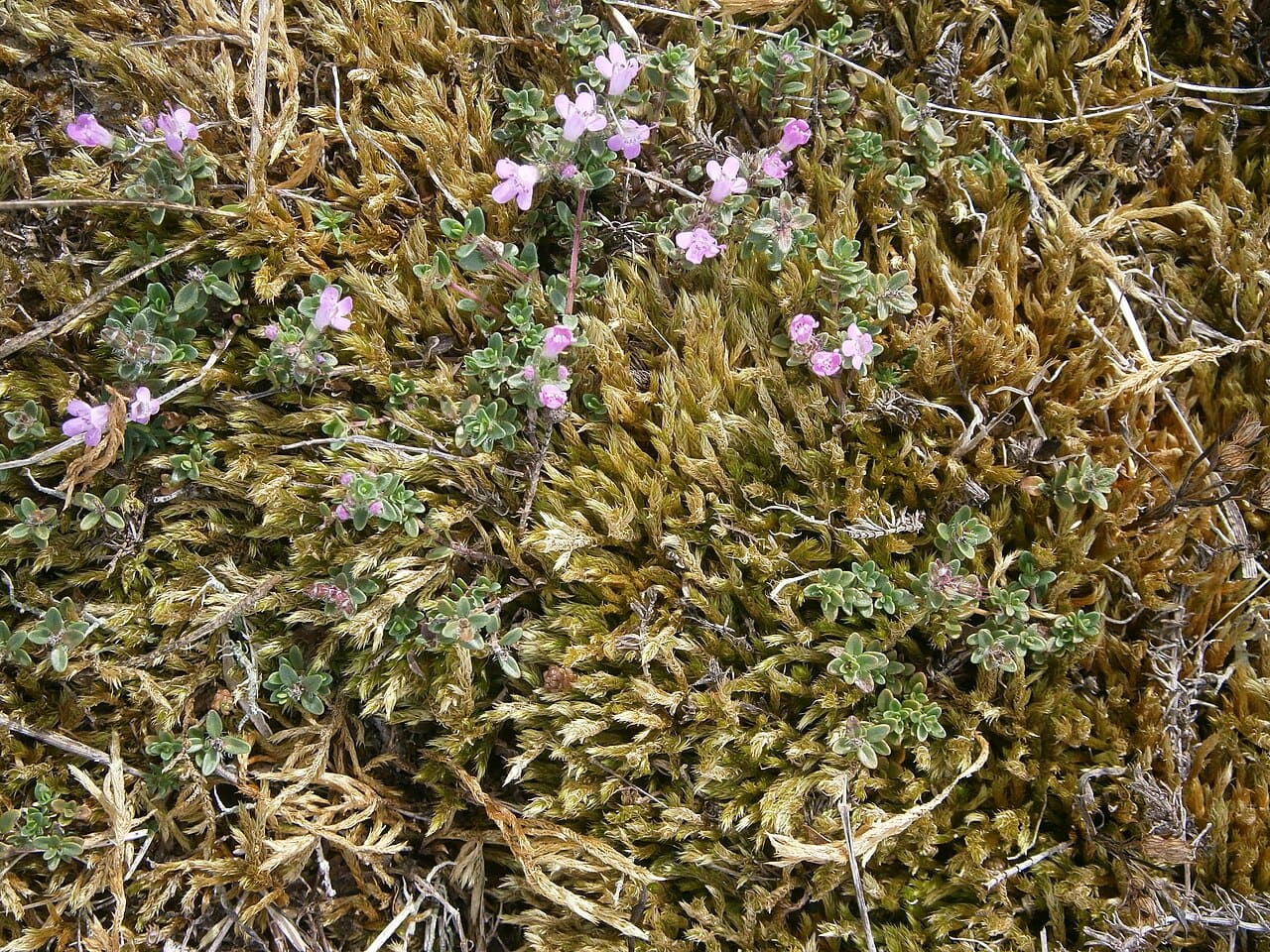
By late June the gaps in a sunny gravel path can turn pink in the space of a week, and a mat of thyme no deeper than a matchbox suddenly has bees on almost every flower head. Garden centres sell most of these mats under one loose heading, and the label that catches the eye most often is red creeping thyme, which in practice opens a dark pink to magenta rather than anything close to post-box red. This page covers the garden varieties the RHS describes, how they behave in British soil, and the short list of things that finish them off.
If you are after the native plant of heaths and chalk grassland, not a garden mat, the wild thyme guide covers where it grows in Norfolk and how it differs from what nurseries sell.
What gets sold as creeping thyme
The names are a muddle, and it helps to accept that early. Nurseries label the same low, mat-forming plants as Thymus serpyllum, Thymus praecox, Thymus coccineus or simply “creeping thyme”, and the RHS plant profiles reflect the confusion with long lists of synonyms. The Coccineus Group, for example, is also listed as Thymus ‘Coccineus’, Thymus ‘Creeping Red’ and Thymus praecox ‘Coccineus’. ‘Russetings’ appears under Thymus serpyllum but carries the synonym Thymus coccineus ‘Russetings’. ‘Doone Valley’ is filed simply as Thymus ‘Doone Valley’, with Thymus citriodorus ‘Doone Valley’ as an alternative name.
What these plants share is a habit. They are evergreen sub-shrubs with trailing stems that hug the ground, tiny aromatic leaves and heads of two-lipped flowers in summer. Stems at the edge of an established mat often root where they touch the soil, so a single plant slowly widens instead of growing taller.
That habit separates them from the shrubby thymes grown for cooking. Common thyme, Thymus vulgaris, makes a bushy plant up to about 30cm tall, and lemon thymes are usually upright too. Creeping kinds stay low enough to walk over, spill across stone and fill a crack between paving slabs.
One more naming point is worth knowing before buying. The RHS lists the garden cultivars covered here as not native to Great Britain or Ireland, even though a true wild Thymus serpyllum does grow in England. That wild plant, known as Breckland thyme, is a nationally rare native confined to dry sandy heaths and grassland over chalk drift in the Brecks, and the Norfolk Wildlife Trust records it at Thetford Heath National Nature Reserve. A pot labelled Thymus serpyllum at a garden centre is almost certainly a selected cultivar, not a piece of that heath.
Buy by the cultivar name on the label and judge the plant on the bench. A tight, even mat with no brown patches in the middle is worth more than any name.
Red creeping thyme and what the label means
Most plants sold as red creeping thyme belong to the Thymus Coccineus Group. The RHS profile describes two-lipped, tubular flowers in summer that are dark pink to magenta, held over very small, dark green, aromatic leaves on a mat about 5cm high. The group carries an Award of Garden Merit, and the RHS also tags it as good for pollinators.
The red reputation comes from contrast. Magenta flowers packed tightly over near-black-green foliage read as a deep red-pink from a few metres away, and set beside a white thyme the effect is stronger still. Up close, with a single flower head held close, the colour is plainly a rich pink.
None of the RHS profiles checked for this page describes a thyme flower as true red. The nearest thing is ‘Doone Valley’, whose rounded flower heads open lavender-pink from buds the RHS describes as red, so for a week or so in early summer the plant carries a reddish cast before the flowers open.
Plants sold as ‘Creeping Red’ are, according to the RHS synonym list, the same Coccineus Group under another name. If two pots in the same nursery bed carry different labels but look identical, that is probably why.
A table of varieties the RHS describes
The table below uses only the descriptions in RHS plant profiles. Where the RHS gives a height only as a broad band of 0.1 to 0.5 metres, it is shown as “low mat” in place of a guessed figure.
| Variety | Flower colour | Height | Habit |
|---|---|---|---|
| Thymus Coccineus Group (‘Creeping Red’) | Dark pink to magenta | About 5cm | Evergreen mat, dark green leaves |
| Thymus serpyllum ‘Pink Chintz’ | Flesh pink | About 5cm | Wide, flat evergreen mat |
| Thymus serpyllum ‘Snowdrift’ | White | About 5cm | Low creeping mat, mid-green leaves |
| Thymus serpyllum var. albus | White | Low mat | Mat-forming, dark green leaves |
| Thymus serpyllum ‘Russetings’ | Pinkish purple | Low mat | Mat of finely hairy trailing stems |
| Thymus serpyllum ‘Elfin’ | Lilac pink | Up to 10cm | Dense mound of trailing stems, grey-green leaves |
| Thymus ‘Doone Valley’ | Lavender pink, from red buds | Up to 10cm | Mat-forming dwarf shrub, dark green leaves splashed yellow |
A few differences matter more than the colour column suggests. ‘Elfin’ builds a dense, slightly domed cushion, not a flat sheet, and its grey-green leaves give it a softer look than the dark-leaved kinds; it suits the top of a wall or the edge of a trough better than open ground. ‘Doone Valley’ is the one to choose for foliage, because the yellow splashes on its leaves keep it interesting after flowering is over, and its alternative name links it to the lemon-scented group covered in our lemon thyme guide.
The white var. albus is rated H4 for hardiness by the RHS, one step below the H5 given to ‘Doone Valley’, ‘Elfin’ and ‘Russetings’. In most of lowland England that makes little practical difference, but it is a reason to give the white form the warmest, best-drained spot available.
‘Pink Chintz’ and ‘Snowdrift’ are the two the RHS names when it discusses thyme as a lawn, both forming evergreen mats about 5cm high, which makes them the obvious pair for anything meant to be walked on.
Buying plants: what to look for
Spring is the best time to buy, when nurseries have fresh stock and the plants go straight into warming soil. Small plugs are cheaper per plant and root quickly, which suits a large area; 9cm pots give a bigger mat to start with and make more sense for a container or a single gap in paving.
Look at the middle of the plant before the label. A healthy creeping thyme is dense and evenly green or grey right across, with no bare, brown centre and no moss creeping in from the edge of the pot. Tip the plant out if the nursery allows it: white roots reaching the sides of the compost are a good sign, while a sodden, sour-smelling root ball suggests the plant has been sitting wet and may already be rotting.
The RHS Award of Garden Merit is worth looking for on the label. Of the creeping kinds covered here, the Coccineus Group carries it, and the RHS recommends the award as a general guide when choosing thyme.
Old plants sometimes appear on the reduced bench in late summer. A pot-bound thyme with a thin centre can still be useful: pull it apart into rooted pieces straight away and plant those, which often gives three or four healthy starts for the price of one tired plant.
Plants labelled only “creeping thyme” or “Thymus serpyllum”, with no cultivar name, can be perfectly good, but treat the flower colour as a surprise until the first summer.
Where creeping thyme grows best
Sun and drainage decide almost everything. The RHS profiles for these cultivars ask for full sun, chalk, loam or sand, and a well-drained soil that is neutral to alkaline, and the profile for ‘Doone Valley’ goes further, calling it very intolerant of winter wet. A thyme mat rarely dies of cold in an English winter. It dies of sitting in cold, wet soil from November to March, when the roots rot and the centre of the mat collapses into brown stems that never recover, and by the time anyone notices in April the damage is usually done. That is why the same plant can thrive on a sandy bank in the Brecks and fail in a lawn-edge border on heavy clay a few miles away, and why the RHS advice for gardens with heavy or persistently damp soil is to grow thyme in a raised bed or a container instead of the open ground. A layer of grit or fine gravel spread around and under the stems helps in two ways: it keeps the foliage off damp soil, and it suppresses weeds that would otherwise seed into the mat.
The best garden spots tend to be the hard, hot ones. Cracks between paving, the joints of a dry-stone wall, a gravel garden, a rock garden and the sunny edge of a path all suit it, and the RHS lists gravel gardens, rock gardens, patios and coastal sites among the uses for these cultivars.
Containers work well. Each plant wants its own pot, 15cm across and 10cm deep as a minimum by RHS reckoning, well supplied with drainage holes and filled with peat-free soil-based compost opened up with horticultural grit, up to a quarter grit by volume. A shallow terracotta pan of ‘Pink Chintz’ on a sunny step is a simple start if your garden soil is clay.
Shade is the other failure. In a spot that gets only a few hours of sun the mat grows thin and stretched, flowers sparsely and lets moss in.
Creeping thyme from seeds or from plants
Packets labelled creeping thyme seeds are easy to find, and they work, with one catch the RHS states plainly: seed from named varieties will not reliably reproduce the parent plant. A packet produces a mat-forming species thyme with whatever flower colour the seedlings happen to have, usually some shade of pink or mauve. It will not produce ‘Russetings’, ‘Elfin’ or the Coccineus Group. The RHS also notes that most named varieties are sold only as plants for this reason.
Where a variable, cheap mat is the aim, for a large area of gravel for instance, seed is a reasonable route. The method in the RHS guide to growing thyme is to sow indoors in spring, scatter the fine seed thinly over the surface of moist peat-free seed compost and leave it uncovered, then keep the tray somewhere warm and bright at 15 to 20°C. Germination usually takes a couple of weeks. Overwatering is the main risk, since thyme seedlings are prone to damping off.
Once seedlings have several leaves, the RHS suggests moving each into its own 7.5cm pot of a soil-based compost such as John Innes No 2, growing them on until well rooted, hardening them off and planting out between mid-spring and early summer. Thyme from seed can take about a year to reach a useful size, so a spring sowing gives a decent mat the following summer. Our guide to growing thyme from seed goes through the timings month by month.
For a named variety, buy one good plant and multiply it. Division in spring or autumn works best for creeping, mat-forming thymes, according to the RHS: lift a mat, pull or cut it into rooted pieces and replant them. Layering is even simpler, because low stems pegged onto the soil in spring or autumn root on their own, and any rooted stems found around the edge of a plant can be potted up. Semi-hardwood cuttings taken in mid to late summer are the other method the RHS lists for the Coccineus Group and ‘Doone Valley’, though ‘Doone Valley’ may need some bottom heat.
Using creeping thyme as a lawn
A creeping thyme lawn is not a grass lawn with a different plant. The RHS discusses thyme in its advice on chamomile lawns and alternatives, where it is put forward for fast-draining ground, dry districts and gardens that cannot be watered. The species Thymus serpyllum and its forms ‘Snowdrift’ and ‘Pink Chintz’ are the ones named, each making a 5cm evergreen carpet. Woolly thyme, Thymus pseudolanuginosus, is mentioned as another low-growing option.
What it will not do is take a football, a dog’s daily circuit or a wheelbarrow. Think of a creeping thyme lawn as a scented carpet for a sunny patch that people cross now and then, with stepping stones on any route used every day. Planting, ground preparation and upkeep are covered in detail on our creeping thyme lawn page.
Planting out and spacing
Plant between mid-spring and early summer, when the soil has warmed and the plants have a full growing season to root before winter. The RHS spacing for thyme generally is 20 to 30cm apart depending on variety, set at the same depth the plant was growing in its pot. For a flat mat such as ‘Pink Chintz’ the closer end of that range closes the gaps sooner.
Planting into paving takes a little more care than planting into open ground. Scrape out the joint between the slabs as deeply as possible, fill it with a gritty, soil-based compost, and push in a small plug or a rooted piece pulled from an established mat. Firm it in with a finger, water it, and keep it watered through the first few dry spells. The same method works for the joints of a dry-stone wall, where a small plant tucked into a pocket of compost will gradually spill down the face of the stone.
Water newly planted thyme until it is clearly growing, then mostly leave it alone. The RHS describes thyme as drought tolerant and rarely in need of watering once established, apart from plants in containers during hot, dry spells.
Trimming, dividing and starting again
Creeping thymes need very little cutting. The RHS advice is a light trim after flowering to remove the spent flower heads, and the profiles for ‘Russetings’ and var. albus add that cutting back after flowering keeps the plants compact. Shears work on a large mat; scissors are kinder on a small one.
Do not cut hard into old, bare stems. Thyme does not always reshoot from old wood, and a scalped mat can stay patchy for a year or more.
Even well-grown mats age. After several years the centre often thins and goes woody while the edges stay green, and at that point division is the fix: lift the plant in spring or autumn, discard the tired middle and replant the vigorous outer pieces. It is quicker than nursing an old plant and costs nothing.
Over a year the work falls into a simple pattern. Planting goes in between mid-spring and early summer, the flowers follow in summer, the trim comes straight after them, and semi-hardwood cuttings can be taken from mid to late summer. Division and layering suit spring and autumn. Winter needs nothing except a check that fallen leaves are not lying on the mat and keeping it wet.
As a side note, thyme flowers have a flavour much like the leaves, and the RHS mentions scattering them over salads. Most creeping cultivars are grown for their looks, not their taste, so a culinary thyme from the herb bed is the better pick for the kitchen, but a few magenta flowers from a clean, unsprayed mat make a good garnish on a summer plate; the thyme substitutes page covers what to use when the herb bed runs short.
Bees, butterflies and the summer flush
The flowering season is when creeping thyme earns its place. Several of the cultivars in the table, including the Coccineus Group, ‘Doone Valley’, ‘Elfin’ and var. albus, carry the RHS Plants for Pollinators label, and on a warm July afternoon a mat in full flower is busy with bees moving from head to head. Anyone planting thyme for insects should keep sprays well away from it and leave the trim until the main flush is over.
Garden cultivars are only part of the story. The native wild thyme of chalk and limestone grassland is the plant on which the large blue butterfly lays its eggs, and its caterpillars feed first on the flower heads before red ants carry them into their nests. That butterfly is now found in Britain only on sites in south-west England where it has been reintroduced, so a Norwich thyme lawn will not attract one, but the link is a reminder that these small, low plants matter to more than bees.
What to watch for
Creeping thyme is usually trouble-free in a warm, sunny, free-draining spot. The problems that do turn up are few and fairly predictable:
- Root rot in damp soil, especially over winter, which shows as a brown, collapsing centre in spring.
- Damping off in seedlings, almost always caused by overwatering the seed tray.
- Slugs and snails eating young shoots on newly planted mats.
- Rosemary beetle and sage or Ligurian leafhoppers damaging leaves, usually not severely.
- Grass and weed seedlings growing up through the mat, which are far easier to pull when small.
Of these, winter wet and invading grass cause most losses. The first is solved by the planting site, the second by ten minutes of hand weeding in spring before the grass roots knit into the thyme.
For a first try in a Norwich garden, take the sunniest metre of path edge or paving you have, plant three pots of one variety there in May, mulch them with grit, and see which still look tight and green after the first wet February.
Questions
Is red creeping thyme actually red?
Not in the way a poppy is red. Plants sold as red creeping thyme usually belong to the Thymus Coccineus Group, which the RHS describes as dark pink to magenta, and one of its listed synonyms is 'Creeping Red'. Against dark green leaves and in a dense sheet the colour reads as a deep red-pink, especially beside white or pale pink thymes, but the individual flowers are magenta rather than scarlet.
Can creeping thyme be grown from seeds?
Yes, but only the species, not named varieties. The RHS notes that seed from cultivars such as 'Russetings' or 'Pink Chintz' does not come true, so a packet of creeping thyme seeds gives you a general mat-forming thyme with variable flower colour. Sow on the surface of moist seed compost in spring at 15 to 20°C, leave the seed uncovered, and expect seedlings within about two weeks.
How much foot traffic will a creeping thyme lawn take?
Occasional footsteps, not daily wear. A creeping thyme lawn suits a sunny, free-draining patch that people cross now and then, such as the edge of a terrace or the ground around a bench. For a route used every day, set stepping stones through the thyme so the plants carry the look of a lawn while the stones take the weight.
When should creeping thyme be cut back?
Straight after the main flush of flowers in summer. Shear or snip off the spent flower stems and a little of the tips, which keeps the mat tight and stops it looking brown and twiggy. Avoid hard cutting into old, bare stems, because thyme does not always regrow from them. If the middle of an old mat has gone thin, divide the healthy edges in spring instead.