
Wild thyme field guide
I Know a Bank Where the Wild Thyme Blows: Meaning and Wild Flowers
Six lines, and every one of them names a plant you could still find in Britain this summer. That is the quiet joke in Oberon’s most famous speech: it sounds like fairyland, and it reads like a list from a hedgerow survey.
I know a bank where the wild thyme blows,
Where oxlips and the nodding violet grows,
Quite overcanopied with luscious woodbine,
With sweet musk-roses, and with eglantine.
There sleeps Titania sometime of the night,
Lulled in these flowers with dances and delight.
The passage comes from A Midsummer Night’s Dream, Act 2, Scene 1. Oberon, king of the fairies, is quarrelling with his queen, Titania. He has sent Puck to fetch a flower whose juice makes the sleeper fall in love with the first creature they see on waking, and here he describes where he will find her asleep so he can use it. The text above follows the Folger Shakespeare Library’s edition, which is the standard reading text online.
What “blows” means
The first word most readers stumble on is “blows”. It has nothing to do with wind. In Shakespeare’s English, to “blow” could mean to bloom or come into flower, a sense that survives today mainly in “full-blown”. A bank where the wild thyme blows is a bank where wild thyme is in flower.
That puts the scene in early to midsummer, which fits a play set around Midsummer. Wild thyme in Britain flowers from late spring through the summer, and on a warm, dry bank it can turn the short turf pink and purple for weeks.
The plants, one by one
Shakespeare chose real plants of the English countryside, most of them sweet-scented. Read as a list, they describe a sunny bank on the edge of a wood or hedgerow, where low flowers grow in the open and climbers drape the scrub above.
Wild thyme
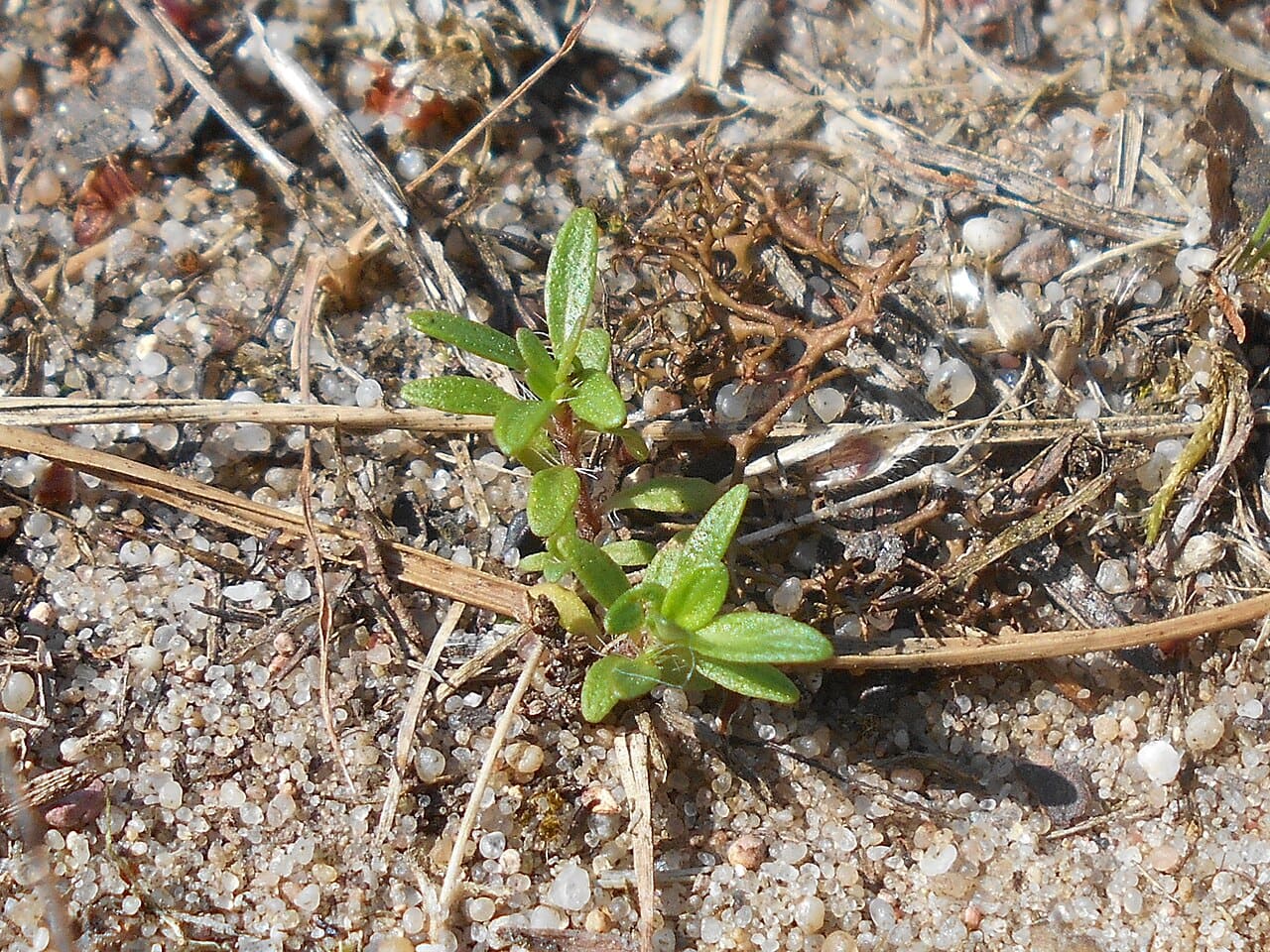
The first plant named and the one this site takes its name from. Wild thyme is a low, mat-forming native of short grassland on chalk and limestone, heaths, cliffs and dunes, the kind of dry, sunny bank the speech describes. Its flowers are small, rosy-purple and very popular with bees, and the whole plant smells of thyme when walked on.
Botanists today recognise three native wild thymes in Britain, separated by the pattern of hairs on their stems, and one of them grows wild only on the Breckland heaths of Norfolk and Suffolk. Shakespeare was not drawing those distinctions. His “wild thyme” is the common plant of banks and hillsides that anyone in Elizabethan England would have recognised. The wild thyme field guide covers the three species and where to see them, and the identification key helps tell them apart.
Oxlips
The oxlip, Primula elatior, is a relative of the primrose and the cowslip. The RHS describes oxlips as similar to cowslips but larger, and the giveaway is that the pale yellow flowers all hang to one side of the stem.
In Britain today the true oxlip is a rarity of East Anglia. The Woodland Trust notes that it is rarely found outside Suffolk, Cambridgeshire and Essex, usually in damp, ancient woods, and it was voted the county flower of Suffolk in Plantlife’s county flower poll. It is easily confused with the “false oxlip”, a common hybrid of primrose and cowslip whose flowers do not all face one way.
The nodding violet
This is the one name that cannot be pinned to a single species with confidence. Shakespeare describes a violet whose flowers droop or “nod”, which suits the way many violet flowers hang on curved stalks. The sweet violet and the common dog violet both grow on banks in England and both are possible readers’ guesses, but the text does not settle it, and sources that name one confidently are guessing.
Woodbine
Woodbine is an old English name for honeysuckle, the wild climber of hedges and wood edges whose cream and pink flowers are strongly scented in the evening. “Quite overcanopied with luscious woodbine” pictures the honeysuckle growing over the shrubs above the bank, roofing it in.
Musk-roses
The RHS identifies Shakespeare’s musk-rose as Rosa arvensis, the field rose, a white-flowered wild rose that scrambles through hedges and woodland edges in southern Britain. Some writers have argued for the garden musk rose, Rosa moschata, instead. The field rose suits the wild setting of the speech better, and it is the reading the RHS gives.
Eglantine
Eglantine is sweet briar, Rosa rubiginosa, a wild rose with pink flowers and leaves that smell of apples when crushed, especially after rain. It turns up repeatedly in Elizabethan poetry as an emblem of sweetness.
Why these flowers
Taken together the list is about scent as much as sight. Thyme, violets, honeysuckle and sweet briar are all plants people notice through the nose first. For a scene where a queen is “lulled” to sleep, a bank thick with fragrance makes sense, and Shakespeare’s audience, who knew these plants from their own lanes and commons, would have smelt the place as they heard it.
There is also an old association between thyme and fairies in English folklore, which may have made wild thyme a natural first choice for Titania’s bed. It is a pleasing connection, though one that is easier to repeat than to trace to a firm source.
Reading the speech in the play
The speech is easy to lift out as a pretty nature poem, and it often is, set to music, printed on cards and posters. In the play its job is darker. Oberon describes Titania’s bower so lovingly because he is about to trick her: he will “streak her eyes” with the flower’s juice so that she falls for whatever she sees first, which turns out to be Bottom wearing a donkey’s head.
That contrast is part of why the lines stay in the memory. The language is all softness and scent, and the intention behind it is mischief. The bank itself is innocent.
The speech in music
The lines have attracted composers for centuries, partly because they already sound like a song.
The best known modern setting is Benjamin Britten’s opera A Midsummer Night’s Dream, first performed on 11 June 1960 at the Aldeburgh Festival on the Suffolk coast. Britten and his partner, the tenor Peter Pears, made the libretto from Shakespeare’s own words, cutting and rearranging the play rather than rewriting it. Britten wrote the part of Oberon for the countertenor Alfred Deller, so the king of the fairies sings in a high, otherworldly male voice, which suits the strangeness of the wood.
That the opera was born in Suffolk adds a local footnote. Oberon’s bank, with its wild thyme and oxlips, describes plants that grow in that same corner of East Anglia, and the first audience heard the speech a short drive from heaths and ancient woods where both still flower.
Why the speech is so easy to remember
Part of the answer is the rhyme. The six lines are three rhyming couplets, blows and grows, woodbine and eglantine, night and delight, and couplets stick in the memory far more easily than blank verse. Oberon speaks most of this scene in unrhymed lines, and the switch to rhyme makes the bank sound like a little enchantment set into the play.
Part of it is the rhythm. The lines run smoothly, with the stresses falling on the plant names, so the list reads like a spell or a charm being recited.
And part of it is the subject. People who know nothing else of the play can picture a sunny bank of flowers, smell the honeysuckle and imagine somewhere soft to sleep. The speech asks for no knowledge of the plot, which is exactly why it gets lifted out and printed on its own.
The name of this site
Wild Thyme Norwich takes its name from the plant, not from the play, but it would be odd to write about wild thyme without this speech. It is very probably the most widely known sentence in English about the plant, and it gets the botany right: wild thyme on a dry, sunny bank, flowering in summer, surrounded by other scented wild flowers of the English countryside.
A short glossary of the old names
Several of the words in the speech have drifted since Shakespeare’s day, and a quick glossary makes the lines easier to read aloud.
Blows: blooms, comes into flower. The same sense survives in “full-blown”.
Overcanopied: covered over as if by a canopy, here by honeysuckle growing on the scrub above the bank.
Luscious: rich and sweet, in this case describing the scent and abundance of the honeysuckle rather than anything to eat.
Woodbine: honeysuckle, a name still used in some parts of Britain.
Eglantine: sweet briar, the wild rose with apple-scented leaves.
Sometime of the night: at some point during the night, sometimes, not every night.
Lulled: soothed to sleep.
Read with those in mind, the speech becomes very plain: here is a bank where wild thyme flowers, oxlips and violets grow, honeysuckle and wild roses hang over it, and the fairy queen sometimes sleeps there, soothed by the flowers and the dancing.
Seeing the plants for yourself
Every plant on Oberon’s bank is a native or long-established wild plant in Britain, and with some planning you can see most of them in a single summer in East Anglia. Wild thyme flowers on chalk grassland and the Breckland heaths from late spring into August. Oxlips flower in spring in a few ancient Suffolk and Cambridgeshire woods. Honeysuckle, field rose and sweet briar are common in hedgerows across the region.
Look, smell and photograph, but leave them where they grow. Uprooting any wild plant without the landowner’s permission is an offence under the Wildlife and Countryside Act 1981, and several of these plants grow on protected sites. If you want wild thyme of your own, garden centres sell native and near-native creeping thymes, and the creeping thyme guide explains which to choose.
And if the line itself is what brought you here, it is worth reading the whole scene once. The bank is two minutes of stage time in a much longer night.
Questions
Where does 'I know a bank where the wild thyme blows' come from?
It is from William Shakespeare's A Midsummer Night's Dream, Act 2, Scene 1. Oberon, king of the fairies, says it to Puck while planning to drop a love potion on his sleeping queen, Titania. The six lines describe the flowery bank where she sleeps, and they are among the most quoted passages in the play.
What does 'blows' mean in 'where the wild thyme blows'?
Here 'blow' is an old verb meaning to bloom or flower, the same sense that survives in 'full-blown'. So the bank is a place where wild thyme flowers, not one where wind blows across it. The meaning was ordinary English in Shakespeare's day and is now mostly found in poetry.
What plants are named in Oberon's speech?
Six: wild thyme, oxlips, the nodding violet, woodbine, musk-roses and eglantine. Woodbine is the old name for honeysuckle, the RHS identifies the musk-rose as Rosa arvensis, the field rose, and eglantine as Rosa rubiginosa, sweet briar. Oxlip is a primrose relative now found wild mainly in East Anglia. The exact violet Shakespeare meant is not certain.
Is the wild thyme in Shakespeare the same plant that grows in Britain today?
It is the same kind of plant: a low, creeping, sweet-smelling native thyme of dry banks and short grassland. Botanists now separate three native British thymes, and Shakespeare was not writing a field guide, so his 'wild thyme' is best read as the common wild thyme any Elizabethan would have known from hillsides and banks.