
Wild thyme field guide
Creeping thyme lawn: how to plant a low, scented patch that lasts
How many plants for your patch
| Area | 20 cm apart | 25 cm apart | 30 cm apart |
|---|---|---|---|
| 1 m² | 25 | 16 | 12 |
| 2 m² | 50 | 32 | 23 |
| 5 m² | 125 | 80 | 56 |
| 10 m² | 250 | 160 | 112 |
| 20 m² | 500 | 320 | 223 |
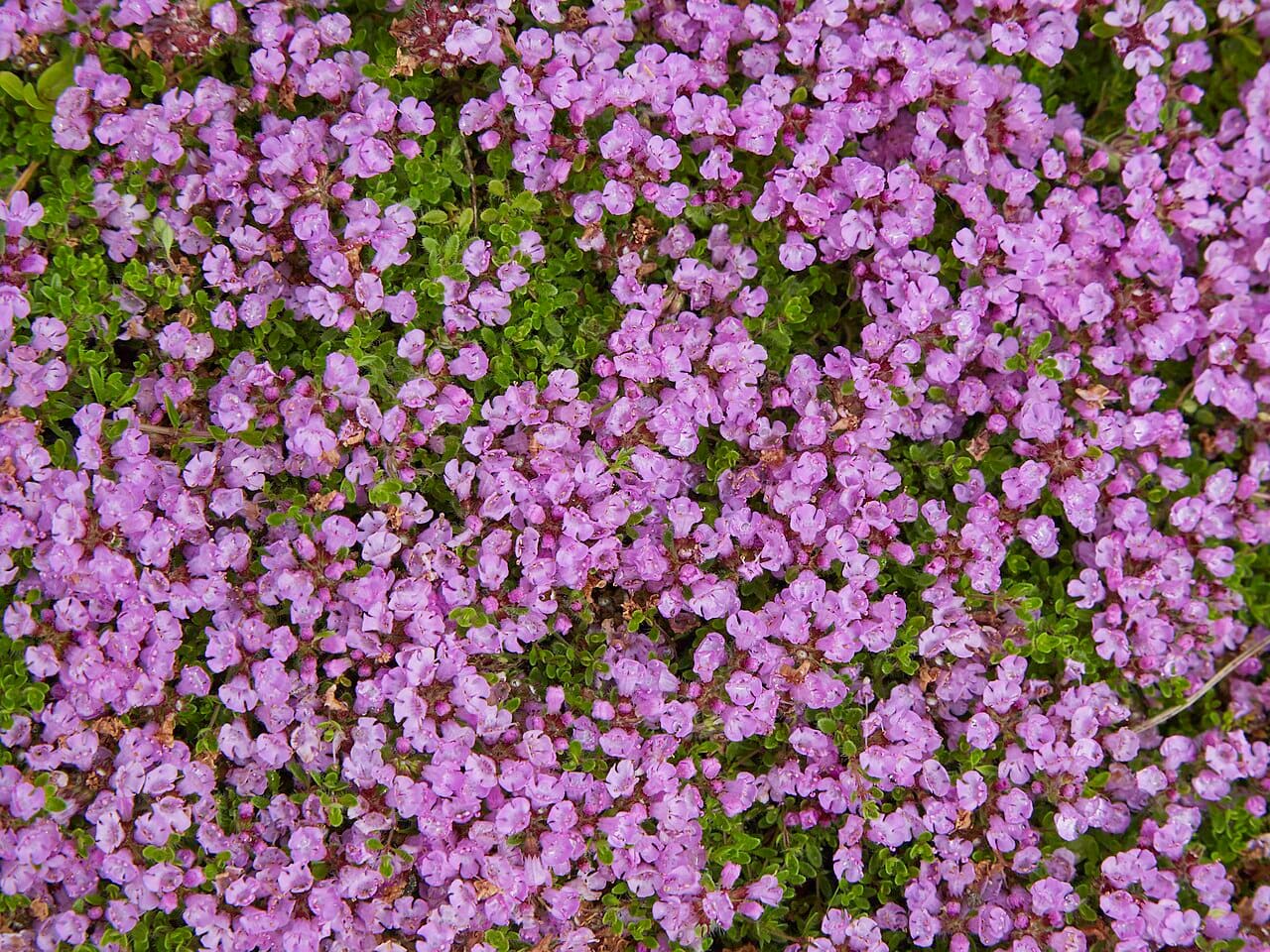
In a dry August the difference shows. Grass on a south-facing bank goes the colour of straw, while a patch of thyme beside it stays green, evergreen leaves intact, and still smells of something when you step on it. That contrast is the whole case for a creeping thyme lawn: it is a plant for hot, dry, sunny ground where turf struggles, not a general replacement for grass.
This page is about making one work. For the varieties themselves, flower colours and heights, the creeping thyme guide has a table of the plants the RHS describes.
Is the site right?
Three things need to be true before buying a single plant. The patch should get sun for most of the day, the soil should drain quickly, and the household should be content with ground that people cross occasionally rather than use daily.
The RHS sets out the case in its advice on chamomile lawns and their alternatives. Chamomile needs moisture, and the RHS suggests that on very free-draining soils, in low-rainfall areas or where watering is not an option, a thyme lawn may be the better choice. East Anglia is among the drier parts of Britain, and gardens on the sandy soils of the Brecks or on light, stony ground fit that description well.
Drainage is the part people most often misjudge. Thyme handles drought without complaint, but it does not survive months of cold, wet roots, and a lawn that looks fine through its first summer can thin badly after one wet winter on heavy soil. If rainwater lies on the surface of the patch for hours after a downpour, or the soil sticks to a spade in a dense, shiny clod, assume it will need work first.
Clay is not hopeless for a small patch. A raised area of gritty, free-draining soil built over the clay can carry a few square metres of thyme. A large flat lawn on untouched clay is a different matter, and grass or a clover mix will serve that ground better.
As an aside, plenty of Norwich sits over chalk, and the city has a long history of chalk and flint mining beneath its streets. The best-known reminder came on 3 March 1988, when a double-decker bus sank into a hole on Earlham Road after an old chalk mine below the road collapsed. Chalk deep underground says nothing about the topsoil in a particular back garden, though, so check your own ground rather than relying on the geology map.
How much walking will it take?
Less than grass, and that should shape the design. A thyme lawn copes with someone crossing it now and then, a few chairs set out for an afternoon, or a cat crossing it on its way to the fence. Daily traffic along the same line wears a path into the mat, and the bruised stems then let weeds in.
The neat answer is stepping stones. Lay flat slabs on the routes people actually use, to the shed, the washing line or the back gate, and plant thyme in the gaps and around the edges. The stones carry the feet and the thyme carries the look. Set the slabs slightly below the surrounding soil, so the thyme can creep over their edges and a mower or a boot never catches a raised corner. Leaving a gap of a few centimetres between slabs gives the thyme room to fill in around them.
Bees are the other thing to plan around. The thymes chosen for lawns flower in summer and pollinating insects work the flowers hard, so a flowering thyme lawn is a poor place for bare feet. Mark that down if children use the garden in June and July.
Which thymes to plant
The RHS names Thymus serpyllum and two of its cultivars, ‘Snowdrift’ and ‘Pink Chintz’, as forming an evergreen mat about 5cm high. ‘Snowdrift’ has white flowers over mid-green leaves; ‘Pink Chintz’ has flesh-pink flowers over dark green. Both are flat enough to read as a lawn, not a rockery.
The RHS also lists woolly thyme, Thymus pseudolanuginosus, as a low-growing option, and the darker Thymus Coccineus Group, sold as red creeping thyme, makes a strong contrast if mixed in. Mixing varieties gives a patchwork that changes colour from one section to the next in summer. Planting a single variety gives a calmer, more lawn-like surface.
Avoid the upright culinary thymes. Common thyme and most lemon thymes grow into small bushes and will not knit into a walkable mat, however closely they are planted.
Pattern is a matter of taste, but it helps to decide before planting. Drifts of one variety blending into another look more natural than a chequerboard, and a white thyme such as ‘Snowdrift’ placed along a path edge shows up well at dusk.
Plant numbers add up quickly. Work out the area in square metres, decide on spacing, and count before ordering, since plugs bought in trays of a single variety are usually far cheaper per plant than individual pots.
Clearing and preparing the ground
This is the step that decides whether the lawn lasts. Every piece of existing grass and every perennial weed root needs to come out before planting, because pulling couch grass or creeping buttercup out of an established thyme mat later is slow, fiddly work that damages the thyme as much as the weed.
Strip existing turf with a spade, then fork through the soil and take out roots by hand. On heavier soil, work in plenty of horticultural grit or fine gravel to open it up. Rake the surface level, firm it lightly by treading, and rake again so the finished patch has no hollows where water can collect.
If there is time, leave the cleared ground for a few weeks and remove whatever weed seedlings appear. Each one pulled then is one fewer growing through the thyme in its first summer.
Planting it out
Plant between mid-spring and early summer. The RHS gives a spacing of 20 to 30cm for thyme depending on variety, and for a lawn the closer end of that range is worth the extra plants, since gaps fill sooner and leave less bare soil for weeds. Set each plant at the depth it was growing in its pot and firm it in.
A top dressing of grit spread between the plants after planting helps in two ways. It keeps the stems off damp soil over winter and slows weed seedlings down while the thyme spreads.
Water the new plants regularly until they are clearly growing, which in a dry Norfolk spring can mean every few days for the first month. After that, thyme rarely needs watering, and overwatering an established lawn does more harm than leaving it dry.
Raising plants at home cuts the cost of a large area. Species thyme from seed gives a mixed but serviceable mat, as explained in our page on growing thyme from seed and in the RHS thyme growing guide, while named varieties such as ‘Pink Chintz’ are best multiplied by dividing established plants in spring or autumn.
Keeping grass out at the edges
A thyme lawn next to an ordinary lawn has a border problem. Grass spreads sideways by runners and seed, and within a season or two it will push into the thyme from any edge it touches, where it grows taller than the mat and shades it out.
A physical edge solves most of it. A strip of metal or timber lawn edging sunk into the soil, a row of bricks laid flush with the surface, or a narrow gravel band between grass and thyme all make a line the grass has to cross in the open, where it is easy to spot and pull. A mowing strip of bricks has a second benefit: the mower wheel runs along it, so the grass edge can be cut cleanly without the blades touching the thyme.
Check the edges each spring and again in late summer. Grass that has crept a few centimetres in can be pulled with a hand fork in minutes, while grass that has been left a full year usually means lifting and replanting that section of thyme.
The first year
The first summer is mostly weeding. Go over the patch every week or two and pull anything that is not thyme while it is still a seedling. It is a quiet, slightly tedious job, and it matters more than anything else you do in that season.
Gaps are normal. Plants rarely spread at the same speed, and by late summer some will have doubled while others have barely moved. Note where the weak spots are.
The following spring, lift a section from the strongest plants, divide it into rooted pieces and replant them in the gaps. Thyme stems that touch the soil often root on their own, and these rooted pieces at the edge of a plant are ideal for patching.
Watching for trouble
Most thyme lawns that fail do so slowly, and the early signs are easy to miss. Brown patches that appear in spring after a wet winter usually point to rotting roots, and the fix is to lift the dead section, add more grit to the soil beneath it and replant with healthy divisions. Moss creeping into the mat suggests the patch is staying too damp or getting too little sun. Slugs and snails can strip young shoots on newly planted plugs, so the first spring is the time to keep an eye on them.
Keeping it going year after year
Upkeep is light but regular. The RHS mentions deadheading to keep thyme lawns neat, and in practice that means one trim with shears once the summer flowering is over, taking off the dead flower stems and a little of the growing tips. It keeps the mat dense and stops it looking twiggy in autumn.
There is no need to mow. A mat 5cm high gives a mower nothing to cut, and running one low over thyme tears the stems.
In autumn, clear fallen leaves off the thyme instead of leaving them to sit on the mat, since a wet layer of leaves through winter is exactly the condition that makes thyme rot. Over winter, keep off the lawn when the ground is waterlogged or frozen.
After several years, parts of the lawn may thin in the middle and turn woody. Lift and divide those plants in spring, replant the vigorous edges, and the patch renews itself without starting from scratch. Back on the wild thyme hub there is more on how the native plant manages the same trick on grazed heath.
If the idea appeals but the commitment does not, try a single square metre next to a sunny back door first, planted with ‘Pink Chintz’ at 20cm spacing and dressed with grit, and see how it looks after its first February.
Questions
Do you need to mow a creeping thyme lawn?
No. The thymes usually chosen for lawns, such as 'Pink Chintz' and 'Snowdrift', form mats about 5cm high, so there is nothing for a mower to do. The only regular cut is a light trim with shears once the summer flowers fade, which removes the dead flower stems and keeps the mat dense. Some people run a mower set very high over a large area instead, but it is not needed.
How long does a thyme lawn take to fill in?
It depends on spacing and on how well the plants root in the first summer. Plants set at the closer end of the 20 to 30cm spacing the RHS gives for thyme knit together sooner than wider plantings. Expect the first full season to show bare ground between plants, and plan to fill any obvious gaps with divisions taken from the strongest plants the following spring.
Is a creeping thyme lawn good for bees?
Yes, while it is flowering. The thymes the RHS suggests for lawns are evergreen and their summer flowers are visited by pollinating insects, and several of the cultivars carry the RHS Plants for Pollinators label. The flip side is practical: a thyme lawn in full flower is not the place to walk barefoot, and children playing on it in June or July should keep shoes on.
Can a thyme lawn grow on clay soil?
Not well. The RHS points to thyme lawns for very free-draining soils and dry areas, and thyme roots rot when they sit in cold, wet ground through winter. On clay you can still grow a small thyme patch by building a raised bed or a deep layer of gritty, free-draining soil over the clay, but a large flat thyme lawn on undisturbed clay is likely to thin and die back within a few winters.